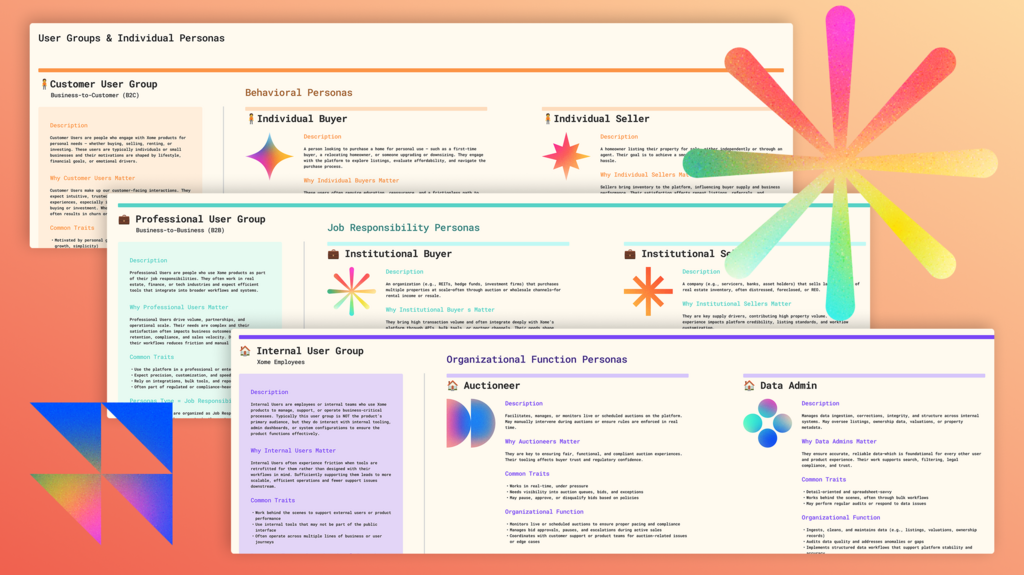
Xome lacked a shared, accessible understanding of its users, leading to misaligned decisions and weak sense-making during a new operational process.
A collaboratively built personas system representing 28 distinct personas across three user groups, now used as a core sense-making artifact during requirements definition and product planning.
Xome
Real Estate Technology
Senior UX Designer (Sole Designer, Lead)
3 weeks
Sense-Making Artifacts
The organization had long operated with an implicit understanding of its users, where critical knowledge lived in the heads of individual team members rather than in a shared, accessible system. As the product team moved toward a more cohesive operation process, this gap became increasingly visible.
Without a clear, agreed-upon definition of who the company serves — across customers, professionals, and internal roles — teams struggled to:
This ambiguity led to misaligned decisions, slowed processes, and inconsistent assumptions across product, design, and adjacent teams. While the need for personas had been discussed informally for years, no formal artifact existed to support sense-making at the scale and complexity the organization required.

This product was shaped by a set of organizational and practical realities that made lightweight or purely academic persona exercises insufficient.
These realities required a solution that was collaborative without being consensus-driven, structured without being rigid, and credible enough to be adopted immediately into real product workflows.
I made a deliberate decision to pursue this work proactively, recognizing that the absence of a shared persona system was blocking progress as the organization moved toward new operational processes. While personas had been mentioned informally in the past, no one had been formally tasked with creating them. I took ownership of identifying the gap and defining a solution.
Several key decisions shaped the success of this project:
Throughout the project, I acted as both facilitator and decision-maker, ensuring the work remained collaborative while still producing a clear, usable artifact that the organization could confidently adopt.
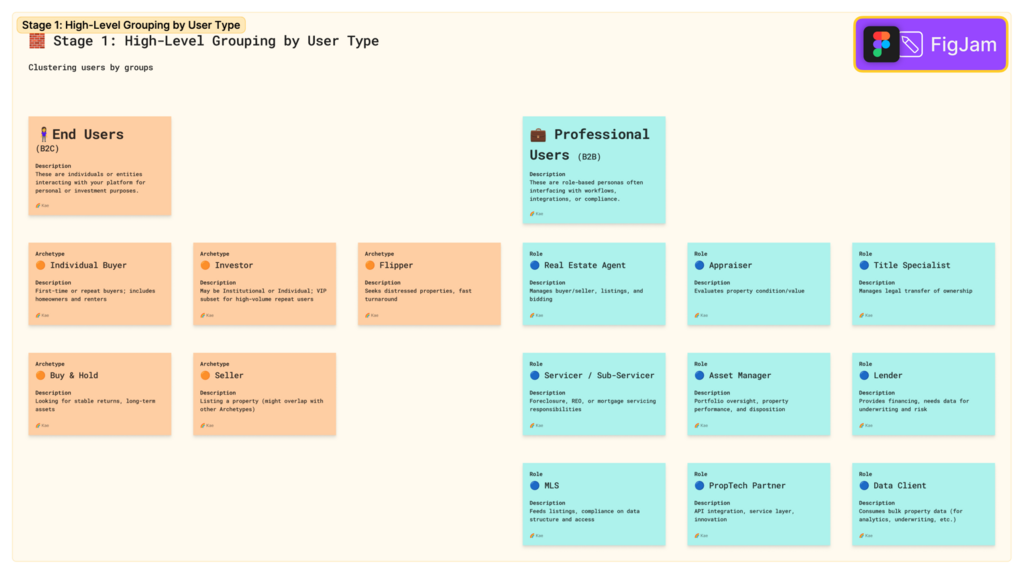
The personas system was intentionally designed as a sense-making framework, not a static documentation exercise. The goal was to create an artifact that teams could actively use during requirements definition, prioritization, and planning without requiring constant upkeep or reinterpretation.
At the core of the strategy was a matrix-based model that reflects the reality of how the organization works.
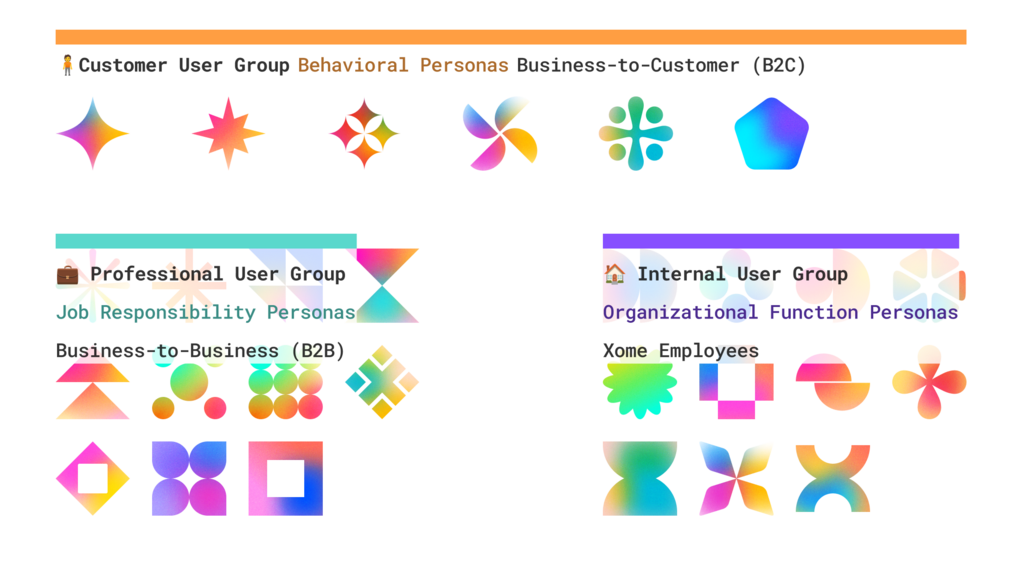
Rather than forcing users into a single persona, personas were grouped into three primary categories:
Each persona represents a distinct set of goals, constraints, behaviors, and decision contexts. Individuals or audiences can map to multiple personas simultaneously, allowing teams to reason about overlap, edge cases, and tradeoffs without oversimplifying complex relationships.
This approach deliberately avoided:
Instead, the system supports comparison, combination, and discussion, which is how personas are actually used in practice.
The visual design of the artifact was treated as a first-class consideration. Given the volume and density of information, clarity and hierarchy were essential to adoption. I leveraged my professional graphic design background to:
By balancing structure with flexibility, the personas system functions as a shared language rather than a prescriptive rule set, supporting ongoing decision-making as the organization evolves.
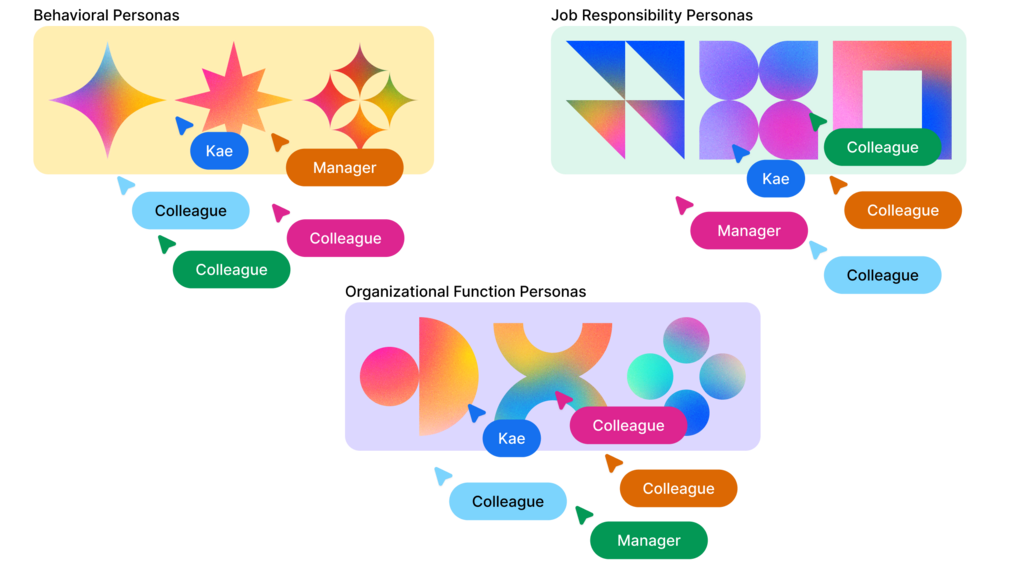
The work was structured around intentional, small-group collaboration, designed to surface expertise while maintaining momentum and clarity.
I planned and facilitated approximately five small-group workshop sessions, each composed of a balanced mix of peers and managers. This structure was chosen deliberately to reduce hierarchy, encourage open contribution, and prevent any single perspective from dominating the conversation.
To accelerate discussion without biasing outcomes, I prepared an initial draft list of persona types based on my understanding of the business. This list was used as a prompt to help participants react, refine, and identify gaps using their lived experience.
Each session focused on:
After the workshops, I synthesized all input independently, translating qualitative discussion into a cohesive, structured personas system. The draft artifact was then presented to the broader team for review and refinement.
Sales, Operations, and Customer Support teams reviewed the final system asynchronously, providing alignment and approval without requiring additional revisions. This swift outcome was made possible by thorough collaboration and validation earlier in the process.
This approach ensured the personas system reflected collective knowledge, which still benefitting from clear ownership, synthesis, and final decision-making.
While this project did not produce traditional quantitative metrics, its impact was immediately visible in how the team worked together and made decisions.
The personas system became a core sense-making artifact during the requirements phase of the new operational process, helping teams clearly identify who they were designing for and why. Conversations that were previously abstract or assumption-driven became more grounded, precise, and efficient.
Additional outcomes included:
The collaboration workshops also had a noticeable effect on team morale. Colleagues expressed appreciation for having a dedicated space to share their expertise and felt meaningfully included in shaping a tool they now rely on.
Just as important, the final artifact demonstrated that complex, unwieldy information could be transformed into something clear, usable, and visually approachable, reinforcing the value of strong design thinking beyond screens and interfaces.
This project reinforced the importance of initiative and ownership in senior UX work. The most impactful contributions are not always assigned; impactful contributions are often identified by recognizing gaps that quietly undermine progress.
It also validated that effective sense-making requires both collaboration and judgment, creating space for collective input while still making decisive structural choices that allow an artifact to function in real-world workflows.
Finally, this work highlighted how UX and visual design skills can combine to support organizational clarity. By treating the personas system as a product in its own right, I was able to deliver a tool that is not only well-used, but well-loved. This artifact is one that teams return to because it genuinely helps them think better.